
The favorite gets the lightest cross-examination
By the time a shortlist is real, most teams have a favorite. That is not a flaw. Instinct built on experience is worth something. But a favorite has a way of collecting generous readings. Its strengths get stated plainly and its weaknesses get softened into "things to keep an eye on."
The result is an evaluation that looks balanced but is not. The site the team wants gets the benefit of every doubt, and the doubt itself never quite makes it onto the page. The failure is not choosing a favorite. It is not writing down the case against it.
Pros and cons, balanced across candidates
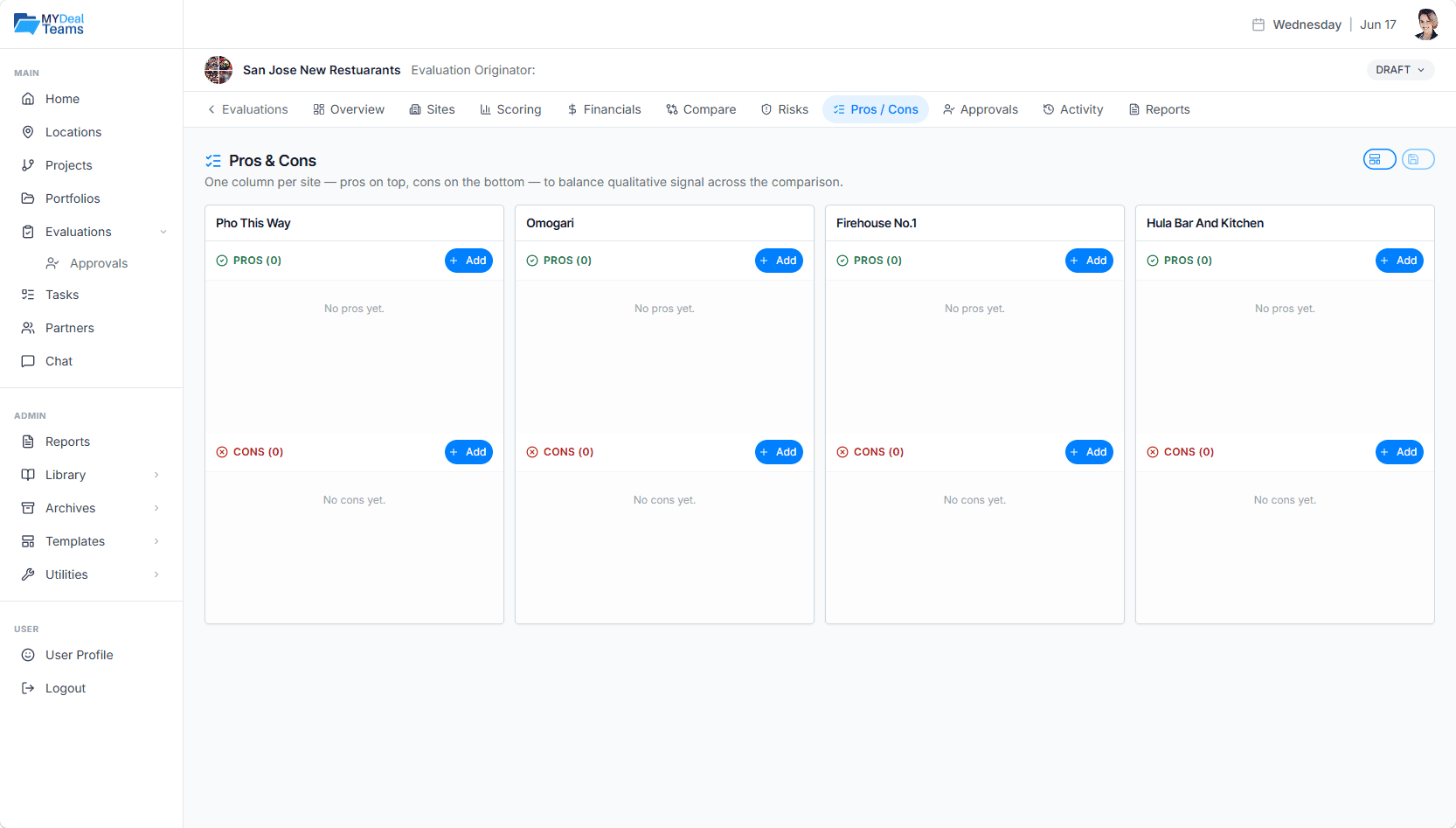
MyDealTeams gives each evaluation a pros-and-cons board, one column per site, with pros on top and cons on the bottom. Each entry is tagged by category and weighted, so a high-weight concern reads differently from a minor one. The structure forces the comparison to be symmetric: every site gets its case for and its case against, in the same format, side by side.
When the cons are captured as first-class entries rather than footnotes, the favorite has to earn its place against its own weaknesses, not just against the other sites.
Writing the con down changes the conversation
There is a real difference between saying "the anchor space has been empty for a while" in a meeting and recording a con that reads "anchor space has been dark for eighteen months." The first is a passing remark that evaporates. The second is a stated fact the team now has to weigh out loud.
The same is true of a con like "volume depends on destination traffic we do not control." Once it is on the board, next to the site everyone likes, it cannot be quietly skipped. The act of writing it down is most of the value, because it converts a vague unease into something the committee has to actually address.
The qualitative signal a score cannot hold
Not everything that matters belongs in a weighted score. A seasonal demand swing, a landlord relationship, a con about a market you do not control: these are real factors that resist a clean numeric weight, and forcing them into one usually distorts both the number and the judgment.
The point of a pros-and-cons board is to give that qualitative signal a home where the committee will see it, without pretending it is something more precise than it is. The best decisions come from holding the score and the narrative together, not from collapsing one into the other. A favorite that survives an honest case against it is a much stronger recommendation than one that was never really challenged.
MyDealTeams is free during Early Access: Community free, Pro $69/month, everything free while we are in Early Access. Nothing to lose, and a deal team to organize.