
The question nobody can answer a year on
A year after a site opens, someone will ask why it was chosen over the alternative. It is a fair question, and it is usually met with a shrug. The scoring lived in one file, the risks in another, the approvals in an inbox, and the reasoning in the heads of people who have since moved on. The decision was made carefully. It simply was not recorded in a way that survives.
The cost of that gap is not only awkwardness in a meeting. It is that the team cannot learn from its own decisions, because it can no longer see how they were actually made.
A chronological audit trail on the evaluation
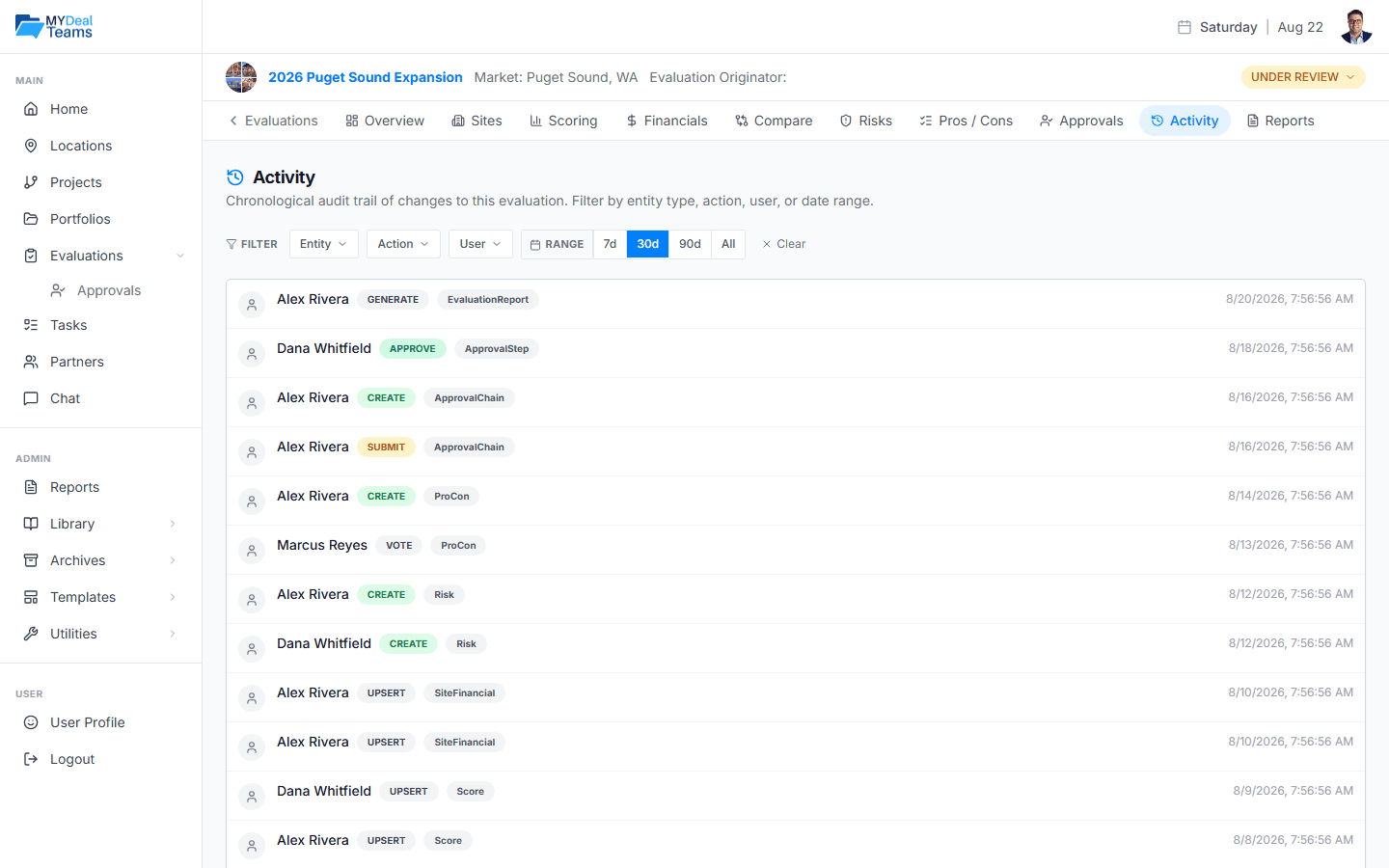
MyDealTeams keeps a chronological activity trail on every evaluation. Each meaningful action is recorded: who generated the report, who approved a step, who created a risk, who changed a score, each with an author and a timestamp. You can filter the trail by type of entity, by action, by user, or by date range, so reconstructing what happened in a given week is a matter of reading, not archaeology.
This is the audit trail that makes defensibility real. Weighted scoring and an approval chain tell you the decision was structured. The activity trail tells you exactly how it unfolded.
Defensibility as a byproduct, not a chore
The reason most audit trails do not exist is that keeping one by hand is miserable, so nobody does it. The only version that works is the one you do not have to maintain. Because the work of evaluating a site happens inside the record, the trail is a byproduct of doing the work, not a separate task bolted onto it.
That is the quiet shift. You are not documenting the decision for its own sake. You are making the decision in a place that documents itself, so the defensible record exists whether or not anyone was thinking about defensibility at the time.
The record that outlasts the people
Teams turn over. The analyst who ran the model leaves, the partner who flagged the risk moves on, and the reasoning goes with them unless it was written down somewhere durable. An activity trail on the deal is institutional memory that does not depend on who is still in the room.
For a coalition of brokers, owners, and internal stakeholders, that shared record matters even more, because no single participant was present for all of it. The trail is the one place where every contribution, from every side of the deal, is recorded in the order it happened. A decision you can reconstruct is a decision you can defend, and a decision you can learn from.
MyDealTeams is free during Early Access: Community free, Pro $69/month, everything free while we are in Early Access. Nothing to lose, and a deal team to organize.